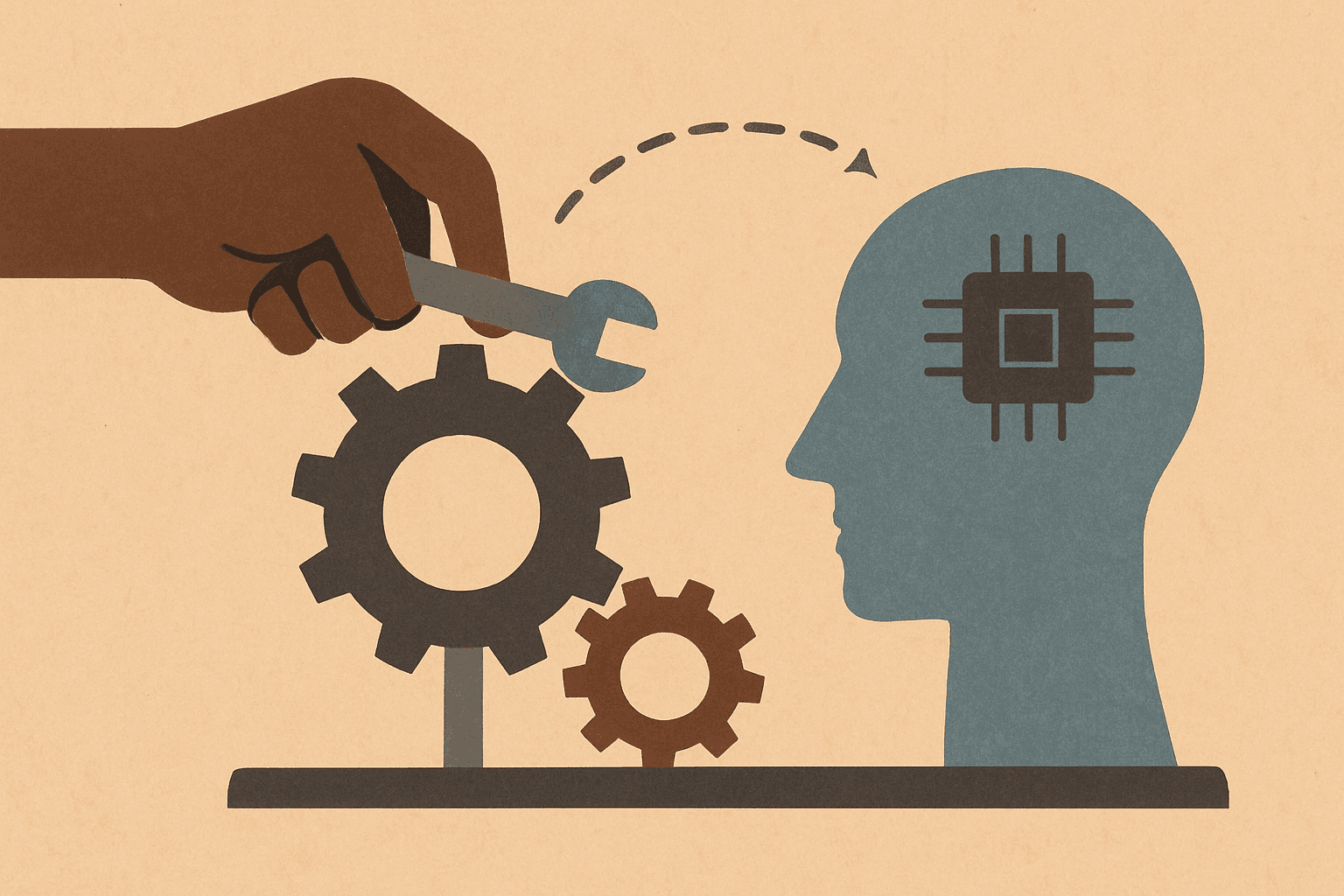
From Engineering to AI Automation: A Personal Career Roadmap for 2025 and Beyond
A first-person roadmap for engineers considering AI automation roles, covering skills gaps, realistic timelines, Canadian salaries, and where to start.
Making the move from traditional engineering into AI automation isn't a pivot so much as a reorientation, most of the hard thinking you already do transfers, but the tooling, the mental models, and the problem framing all need rebuilding. This roadmap covers what that process actually looks like, honestly, from someone who has worked through it.
Why I Started Thinking Seriously About This Shift
I remember the exact moment it clicked. I was sitting at my desk running the same FEA simulation loop for the fourth time that week, same geometry family, same boundary conditions, same report template waiting to be filled, and I thought: a script could do this. Not someday. Right now. It wasn't a crisis. It was almost embarrassing, the way small recognitions are.
By 2023, the feeling had a name and a cause. That year marked a genuine inflection point: large language models entered professional workflows at a speed most organizations hadn't prepared for. For me, the fragility showed up in routine tasks first, drawing reviews, tolerance check documentation, the kind of structured but repetitive engineering work that fills the bottom third of a senior engineer's week. None of it felt like the reason I'd studied engineering. That dissonance is worth taking seriously rather than rationalizing away.
The WEF Future of Jobs Report 2025 projects 85 million jobs displaced by automation by mid-decade, offset by 97 million new roles, a net positive, but only for those who reposition. McKinsey estimates that 60–70% of current work activities are technically automatable with tools that already exist. The data on engineering specifically, available through the Bureau of Labor Statistics, shows that roles with high procedural and repetitive task content face the most structural pressure. If you want to dig further into how career data reads across technical fields, the /blog has more on that.
What's changing isn't the need for engineers, it's the composition of the engineer's role. Design and production tasks that once required hours of procedural effort are being augmented by AI tooling, freeing engineering judgment for work that actually requires it: ambiguous constraints, novel failure modes, cross-functional decisions. By 2025, the clearest pattern is not replacement but redistribution. The engineer who understands both the domain and the automation layer becomes significantly harder to replace than one who does only either.
What Does an AI Automation Engineer Actually Do?
An automation engineer does something distinct from a software engineer or systems designer: they build workflows and decision-augmentation systems, usually on top of existing models and APIs rather than developing them from scratch. The role sits between software engineering, MLOps, and business process design, which is why it's hard to define cleanly and why the comparison below is more useful than a job description.
| Dimension | AI Automation Engineer | Software Engineer | MLOps Engineer |
|---|---|---|---|
| Primary Focus | Workflow automation, LLM integration | Product feature development | Model deployment and infrastructure |
| Core Tools | n8n, LangChain, OpenAI API, Python | React, Node.js, databases | Kubernetes, MLflow, cloud platforms |
| Output Type | Automated business workflows, agents | Shipped software products | Reliable model pipelines |
| Engineering Proximity | Process and decision layer | Application layer | Infrastructure layer |
The list of what's being automated is longer than most engineers expect. By 2025, automation solutions are actively handling code review and static analysis, documentation generation from structured inputs, simulation pre-processing and mesh setup, compliance checking against regulatory documents, materials sourcing and substitution analysis, drawing interpretation using vision models, report generation from test results, and production scheduling optimization in manufacturing environments.
A realistic day: morning is reviewing an automated compliance report the system flagged overnight, not reading from scratch, but auditing the model's reasoning against the actual regulation text. Mid-morning is a stakeholder meeting where you're explaining why the machine got three out of four recommendations right and what overriding the fourth one actually means for the project. Afternoon is building a new integration between a language model and an internal data system, which requires understanding both the API schema and the business logic the workflow is supposed to serve.
The intelligence in this role is mostly about knowing when not to trust the model. I keep the NIST AI Risk Management Framework open as a governance reference precisely because the default instinct is to trust output that looks coherent. You can see more about how I approach this in practice at /.
AI is replacing procedural cognition, not engineering judgment. The real engineering problems, the ones involving novel constraints, physical ambiguity, or genuine technical uncertainty, still require a human. What's going away is the procedural scaffolding around those problems.
The Skills Gap I Had to Honestly Reckon With
Most people approaching AI automation overestimate how much their existing skills transfer and underestimate how much new mental infrastructure they need to build. Not new tools, those you can learn in weeks. A new way of framing problems entirely. That gap is real, it's specific, and nobody in a job posting will tell you exactly where it is.
The technical foundation for automation engineering in 2025 looks like this: Python as the non-negotiable lingua franca; REST APIs for integrating external services and data sources programmatically; LLM orchestration frameworks like LangChain or LlamaIndex for chaining model calls into coherent workflows; data schema design for structuring inputs and outputs so machine learning algorithms can work with them reliably; basic ML concepts to understand how models fail; GitHub for version control and portfolio management; and workflow automation tools like n8n, Zapier, or Make for no-code/low-code automation layers.
The transferable strengths from your engineering background are real and worth naming. Engineering training builds systems thinking, the ability to hold multiple interacting constraints in mind simultaneously. It also instills tolerance for precise constraint, which turns out to be exactly what good prompt engineering requires: specificity, iteration, and a willingness to test rather than assume. Documentation discipline transfers directly. So does debugging under pressure. These aren't small advantages. The design thinking embedded in most engineering programs is genuinely applicable to workflow architecture.
The gaps are equally specific. Probabilistic thinking is the biggest one: engineers trained on deterministic systems find it genuinely uncomfortable to work with outputs that are right 85% of the time by design. Data science framing, thinking in distributions rather than point values, doesn't come naturally from most engineering curricula. The other gap is business problem framing: translating a stakeholder's vague operational pain into a scoped automation specification. That skill requires practice on real projects.
Three soft skills that genuinely determine success in this role: first, translating ambiguous business needs into a precise automation spec, which is harder than it sounds when the stakeholder doesn't know what they want. Second, communicating model limitations to non-technical stakeholders without losing their confidence in the system. Third, managing expectations on AI project timelines, where the first 80% of progress happens fast and the last 20% takes longer than the entire project seemed to warrant. These are the role's real difficulty, not the Python.
A Practical Transition Roadmap, Step by Step
Structured technical career transitions average 12–18 months when approached with deliberate sequencing, compared to 3 or more years of unstructured self-study. That gap isn't motivational, it's architectural. A roadmap isn't aspirational decoration; it's a compression strategy.
The honest range: 9 months minimum for someone already fluent in Python and software development; 18–24 months for someone coming from non-software engineering disciplines like mechanical or civil. The timeline depends on how much Python you have, whether you have a real project to work on during the learning process, and whether you have access to people working in the field.
Build your technical foundation in layers, each one enables the next. Start with Python for scripting, data manipulation, and basic automation. Then learn REST APIs to understand how to consume and integrate third-party services. Move into LLMs via API through OpenAI or Anthropic; understand token limits, prompt structure, and cost management before touching orchestration. Learn LangChain or LlamaIndex for orchestration frameworks that let you chain model calls, manage memory, and connect to data sources. Pick up n8n or Zapier for visual workflow tools that automate business processes without writing every connection from scratch. Finally, use GitHub for version control and the public portfolio layer.
The most common mistake is scope inflation. Pick one real workflow to automate, not a whole system, not a platform, one workflow, and finish it completely. Practical experience on a small finished project beats an ambitious unfinished one for career positioning every time, because finished work can be shown and explained. A script that automatically formats engineering reports from structured inputs, published to GitHub with a README, demonstrates more than a half-built agent framework with 47 open issues. Building in public is the credential here.
Be direct about certifications: Google's Professional Machine Learning Engineer certification and AWS's AI Practitioner certification are worth pursuing because they force structured knowledge and are recognized by hiring teams. DeepLearning.AI's short courses are worth the time because they're built by practitioners. What isn't worth much: cert stacking without shipping project work. The credential signals that you can learn; the GitHub repository signals that you have.
Lead with systems thinking and constraint management when repositioning your career, not with your domain specialization. The context is useful here: engineering skills are documented as durable and transferable. The narrative is: I've spent years solving complex constraint problems under real conditions; now I'm applying that same rigor to AI workflow design. Your LinkedIn profile and GitHub portfolio need to tell that story before your resume does. For more on career repositioning framing, the /blog has related posts worth reading.
Career Paths and Salary Expectations in Canada
Canada's engineering workforce has historically concentrated in resource extraction, civil infrastructure, and manufacturing. The AI automation wave is landing on a profession that hasn't faced structural pressure quite like this since the CAD/CAM transition of the 1980s, which, incidentally, also produced more engineering jobs than it displaced, once the workforce adapted. That historical context matters for reading current salary and hiring data without either catastrophizing or complacency.
From an engineering background, the most realistic initial targets are individual contributor automation engineers, building and maintaining automated workflows within a team, or solutions architects who design the automation layer for a business unit. From there, paths diverge into AI product management, where domain knowledge becomes a genuine asset, or independent consulting, where the combination of engineering credibility and AI capability commands strong rates.
In Canada, automation engineers working in AI-adjacent roles are seeing compensation in the CAD $95,000–$160,000 range depending on seniority and location. Toronto and Vancouver trend toward the upper end due to competitive demand from financial services and technology firms. Calgary is seeing upward movement driven by energy sector digitization. The WEF Future of Jobs Report 2025 net-positive job projection for AI-adjacent roles is already showing up in supply/demand pressure on compensation, there are more open roles than qualified candidates in most Canadian markets.
| Role | Median Salary (CAD) | Typical Industry | Entry Requirement |
|---|---|---|---|
| AI Automation Engineer | $105,000–$135,000 | Fintech, manufacturing, energy | Python, LLM API experience, 1+ project |
| MLOps Engineer | $115,000–$150,000 | Tech, pharma, financial services | Cloud platforms, ML pipeline experience |
| AI Solutions Architect | $130,000–$160,000 | Consulting, enterprise tech | Systems design, cross-functional experience |
| Data/AI Analyst | $85,000–$110,000 | Government, healthcare, retail | SQL, data visualization, basic ML concepts |
The job market in Canada is most active in five sectors: fintech and banking automating compliance monitoring, fraud detection workflows, and customer service escalation routing; energy and utilities optimizing predictive maintenance, energy consumption analysis, and regulatory reporting; federal government tech modernization integrating legacy systems and automating document processing; advanced manufacturing automating quality inspection, production scheduling, and supply chain decision support; and healthcare informatics automating clinical documentation, diagnostic workflow support, and administrative business process automation.
Key Takeaways
- The transition from engineering to AI automation realistically takes 12–18 months with structured learning, closer to 9 months with a Python background, 18–24 months from non-software engineering disciplines.
- Priority skills: Python fluency, REST API integration, LLM orchestration, and at least one workflow automation tool; technical skills matter less than the ability to frame business problems precisely.
- Canadian compensation for this role runs CAD $95,000–$160,000 depending on seniority and city, with upward pressure across most markets due to a qualified-candidate shortage.
- The role is distinct from MLOps (which is infrastructure-focused) and from ML engineering (which involves model development); AI automation engineering is about integrating and orchestrating existing models into real workflows.
- The single most useful thing to do this week: identify one repetitive workflow in your current work, automate any part of it in Python, and publish it to GitHub, scope down until it's finishable.
FAQ
Do I need a machine learning background to become an AI automation engineer?
No, most AI automation roles do not require a machine learning background. The distinction matters: ML engineering involves developing and training models, which requires statistics expertise. AI automation engineering involves integrating and orchestrating existing models into business workflows. You need to understand how models behave and fail, but you don't need to build them. Learning Python and one language model API gets you further faster than a machine learning theory course for most automation roles.
Is AI automation engineering a stable long-term career path?
It's stable if you keep learning; it's precarious if you treat it as a fixed credential. The structural signals are positive: the WEF projects net job creation in AI-adjacent roles through the decade, and NIST's AI governance frameworks represent institutional maturation, organizations are building compliance and risk infrastructure around AI, which requires practitioners with engineering judgment, not just model access. Autonomous systems governance is becoming a professional discipline. That creates durable demand for people who understand both the engineering and the accountability layer.
Can someone from mechanical or civil engineering make this transition?
Yes, though the timeline is longer, typically 18–24 months versus the 9–12 months needed by someone already working in software. The core challenge isn't domain knowledge; it's building Python fluency and probabilistic thinking from scratch. The assets that transfer well include systems-level constraint thinking, tolerance for ambiguity in specifications, and documentation and testing discipline.
The industrial revolution parallel is useful here: each major technological shift has ultimately absorbed domain experts who adapted, not just technologists who built the new tools. Mechanical and civil engineers who led the CAD transition didn't become computer scientists, they became better engineers. The same pattern applies now. Understanding language model capabilities as an engineering tool, not a research object, is what the transition actually requires.
Whether you came from data scientists or structural analysis, the deeply practical and intellectually rigorous nature of automation work rewards engineering rigor regardless of subdiscipline. The iterative testing pattern of workflow refinement, testing output, understanding failure modes, refining inputs, is something engineers already know how to do; they just haven't applied it to model outputs yet. Privacy policy and data handling considerations are also part of the governance layer worth understanding early, particularly when you're building workflows that interact with sensitive information or regulatory environments. That governance literacy distinguishes competent automation engineers from ones who treat models as black boxes and delegate accountability.