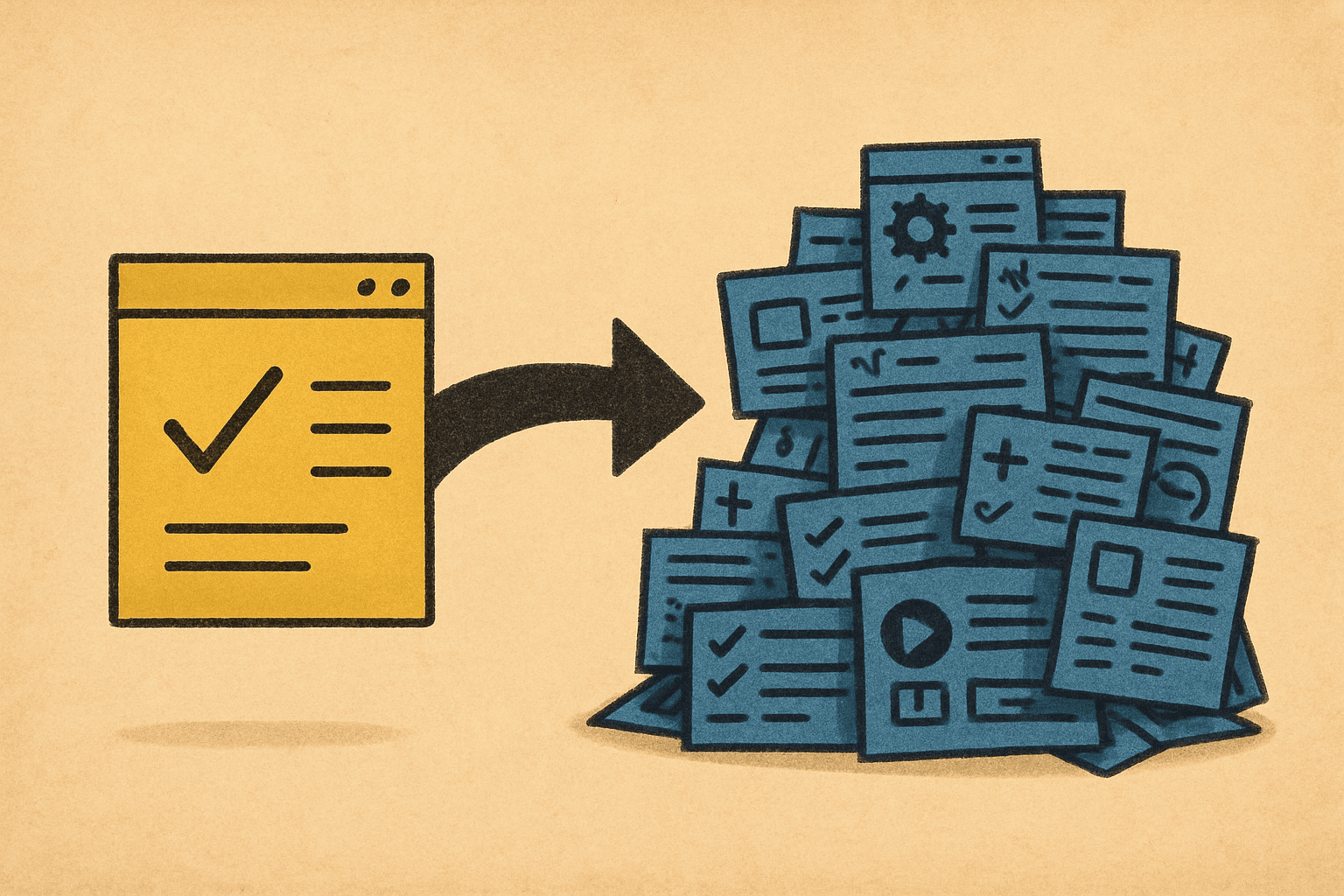
Why Focused Software Beats Feature Bloat
Feature bloat sneaks in one reasonable addition at a time. Here's why focused software serves users better, and how I think about scope when I build.
Every feature added to a product carries a hidden tax, paid by the user in attention and eroded trust. In this essay, I trace how bloat accumulates, why it quietly undermines the software people actually pay for, and how staying narrow is harder, and more valuable, than it looks.
The Moment I Realized My Tools Were Working Against Me
I remember opening a project management suite I'd been using for about six months and genuinely not knowing where to go. I had a simple task: mark something complete and leave a note for the next person. That's it. But the screen in front of me had nested menus, a settings panel I'd never opened, a sidebar that showed different things depending on how I'd arrived at the view, and about eleven icons whose meaning I had to hover over to decode. By the time I'd found the right place to post the comment, I'd forgotten the actual thought I'd wanted to leave.
What struck me later was that this wasn't a badly made product. The team behind it had clearly worked hard. Every feature I didn't need had a use case, someone, somewhere, had asked for it. The roadmap had been executed. The software had grown.
But it had grown without a clear idea of who it was for. The user, me, in that moment, trying to do one ordinary thing, had become an afterthought to the product's ambition. That's not a technical failure. It's a focus failure. For deeper background, see Learn what applied AI practices mean.
What Feature Bloat Actually Is (And How It Sneaks In)
Bloat isn't what bad teams create. That's the thing that makes preventing feature bloat genuinely difficult to address. Bloat is what happens when incentive structures go unexamined for long enough.
It usually enters through recognizable doors. The first is roadmap pressure: stakeholders want visible progress, and new features are the most legible form of progress available. The second is enterprise sales requirements, the "we need X to close the deal" conversation that moves a single customer's edge case into the product for everyone. The third is the "just add a toggle" rationalization: if we make it optional, it doesn't count. It does count. Every option a user can configure is an option they have to notice, evaluate, and decide about.
The fourth vector is the most insidious: incremental accumulation. Each individual feature is defensible. Each one solves a real problem for someone on the development team's radar. Seen in isolation, none of them look like a mistake. It's only in aggregate, when the toolbar has twenty-two buttons and the settings menu has seven categories, that the cost becomes apparent.
And here's what makes it structurally hard to fix: the product team almost never experiences the cost of what they add. The user absorbs it. The three seconds of confusion, the wrong click, the moment of not-quite-trusting, those don't show up in sprint reviews. They're externalized. This is why feature creep is a documented, studied problem in user experience research, not just something individual designers complain about. The incentives to add are local and immediate; the costs are distributed and delayed.
The Cognitive Cost Nobody Puts in the Release Notes
Here's the part that usually goes unspoken in product development conversations: every feature is a tax, and the user pays it whether they use the feature or not.
The mechanism is working memory. Human working memory, the mental space where we hold and manipulate information in the moment, can handle roughly seven items at a time, plus or minus two. This is Miller's Law, and while the precise number has been debated since the 1950s, the underlying point hasn't: we have a finite capacity for holding complexity in our heads at once. Every unfamiliar button in a toolbar, every submenu that might contain what I'm looking for, every modal I have to dismiss, each one draws on that capacity. None of it is free.
This cost is essentially invisible in analytics. It doesn't show up as an error. It shows up as churn, as support tickets filed by users who've lost confidence in their own ability to use the software, as the vague description "I never really got into it" when someone cancels their subscription. The cost is real; it's just easy to attribute to something else.
The principle that ought to govern this, user-centered design, is straightforward: build only what users need, oriented around how they actually think and work, not around what the product roadmap allows. That's harder than it sounds, because it requires the team to prioritize ruthlessly and to treat subtraction as valid work.
Focused software doesn't just remove features. It removes decisions the user shouldn't have to make. That's a different framing, and I think it's a more honest one. The goal isn't minimalism as aesthetic; it's respect for attention as a finite resource.
Focused Software Forces Better Decisions, On Both Sides
There's something clarifying about a tool that does one thing. As a user, you can't outsource the decision about what you want to accomplish to a menu of options. The constraint forces honesty. You have to arrive knowing what you need.
I notice this most with focused writing tools, the ones that strip out everything except the text and maybe a word count. There's no view or add new feature, no settings panel to fiddle with, no comment thread to get pulled into. You have to write. Some people find that oppressive. I find it clarifying. The tool's narrowness makes my intention visible to me.
On the builder's side, the effect is equally sharp. A narrow scope forces honest prioritization in a way that a broad scope simply doesn't. You can't hide weak thinking behind a long feature list. The question you have to answer, "what does this need to do before it needs to do anything else?", is a harder question than it looks.
This is the real intellectual content of the minimum viable product concept, which I think gets misread as a shipping strategy when it's actually a philosophical commitment. An MVP isn't a weak product. It isn't a product you're embarrassed to show. It's a focused product, one that does the important thing well and doesn't yet do the other things, because the other things aren't yet understood well enough to build correctly.
That distinction, between weak and focused, matters a lot. A focused invoicing tool that handles payment tracking, sends reminders, and produces clean records is a strong product. The fact that it doesn't also manage contracts or run payroll isn't a gap. It's a decision.
The Business Case Against Bloat (That Most Teams Ignore)
The standard objection to focus is commercial: more features signal more value, more value justifies the price, more price means more revenue. I understand the logic. I think it's wrong, and not just on principle.
Consider maintenance cost first. Every feature added to a codebase must be maintained, tested, and supported in every future version. The long-run cost of features is non-linear, it compounds, because features interact. Add enough features and you get a combinatorial testing problem. The team expands to manage the complexity, management overhead increases, and you're now running a significantly more expensive operation than you were before. This is where a feature factory culture can take over, where output of features becomes the measure of success, divorced from their actual impact on the product or user outcomes.
Support cost follows directly. Feature-heavy software generates disproportionately more support tickets, requires more documentation, and creates more surface area for users to get lost in. That's a real staffing and time cost, whether the customer sees it or not.
Then there's retention. Users who can reliably accomplish the job they hired the software to do are more likely to renew. It sounds obvious, but the implication is important: a product that does one thing well and is consistently predictable will often retain customers more effectively than a product that does twelve things inconsistently. Word-of-mouth gets sharper too. "You should try this, it does X and it does it extremely well" is more compelling than a features comparison spreadsheet.
There's a privacy and policy dimension here as well. More features typically mean more data collection, more complexity in the privacy policy, and more compliance exposure. Every time a feature requires new data handling, that's an overhead cost and a potential liability that a focused product simply doesn't carry.
What "Focused" Doesn't Mean
I want to hold this carefully, because the argument for focus can tip into something self-congratulatory if I'm not precise.
Focused software is not sparse software. It's not unfinished software. It's not software that refuses to grow or improve or add depth. Using "simplicity" as cover for not doing the hard work of building something well is its own kind of failure, and it's not what I'm arguing for.
The distinction I'd draw is between breadth and depth. Adding breadth means adding new categories of functionality, new things the product does. Adding depth means doing the existing thing with more craft, more reliability, more attention to the edge cases that real users hit. A focused product can be extremely sophisticated. It can have years of thoughtful development behind it. It just knows its own edges.
One structural tool for maintaining that focus as software scales is the design system, a coherent set of reusable patterns that ensure new development stays consistent with the product's existing logic rather than accreting new visual and interaction languages with each release. The GOV.UK Service Manual's approach to design systems is a clean example of this working at institutional scale: pattern-driven development that allows a product to grow without losing coherence.
What I'd add is that staying focused over time isn't a one-time decision. It's an active posture that requires maintenance. The pressure to add is continuous. The decision to hold the line has to be made repeatedly, in specific moments, against specific requests. Managing feature bloat is really about managing this pressure systematically, not just responding to individual requests. That's the harder part.
How I Think About Scope When I'm Building
When I'm scoping something new, the first question I try to answer is: what is the one thing this needs to do well? Not the list of things it should eventually do, not the feature set that would make it competitive in some category, the one thing. If I can't describe what it does in one sentence, it's already doing too much in my head, and that usually means the build will sprawl.
The second question is: what's the first thing to cut when scope expands? Because scope will expand. Someone, a client, a stakeholder, sometimes just my own restless curiosity at 11pm, will ask for one more feature. Having a clear answer to "what goes if something comes in" is more useful than having a strong opinion about scope in theory.
I've found privacy and policy considerations to be a genuinely useful forcing function in this. If avoiding feature sprawl requires discipline, treating data collection as a scope signal is one discipline that works. If adding a feature requires new data collection, or changes what needs to be disclosed in the privacy policy or terms of service, or creates compliance exposure that didn't exist before, that's a real cost that's easy to undercount in the moment. Treating it as a scope signal, not just a legal checkbox, has helped me say no to things I might otherwise have rationalized into the product.
The hardest part of scope management is that it's ongoing. It's not a gate at the start of development; it's a discipline that runs through the whole life of a product. Saying no after yes has already been said, walking back a commitment, removing a feature that users have started to rely on, accepting the friction that comes with simplification, that's where the actual work is. Management this can lead to friction with stakeholders, but it's necessary friction if the product is to stay coherent.
I don't always get it right. But I've found that treating focus as an active decision, not a default, keeps me more honest about what I'm building and why.
The Software Worth Paying For Is Usually the Narrowest
Think about the software you've kept. Not the software you have, the software you've renewed without thinking about it, recommended to someone without being asked, returned to after trying something else.
My guess is that most of it does a small number of things with genuine reliability. Not because the teams behind it were less ambitious, but because at some point they chose to go deep rather than wide, and held that choice under the kind of pressure that usually pushes products toward sprawl.
That choice is, I think, a form of respect. Respect for the customer's time, which is finite. Respect for the problem being solved, which deserves real attention rather than coverage. Respect for the craft of building something that does what it says, consistently, without requiring the user to learn a new language every time they open the product.
Feature-heavy software often signals that a team is trying hard. Focused software signals that a team knows what it's for. Both require effort. Only one of them puts that effort in the right place. The tools worth paying for, the ones people describe not as powerful but as right, are almost always the ones that stayed focused.
Key takeaways
- Every feature added to a product is a cost transferred to the user in attention and orientation time, not just a capability added to the system.
- Feature creep enters through recognizable structural pressures, stakeholder roadmaps, enterprise sales requirements, incremental accumulation, and is a documented user experience research problem, not a personal failing.
- Cognitive load is invisible in analytics but shows up in churn, support tickets, and user abandonment; focused software removes decisions users shouldn't have to make.
- Minimum viable product thinking is a philosophical commitment to focus, not a shortcut, an MVP is a focused product, not a weak one.
- Staying focused is an active, ongoing discipline: scope management is not a gate at the start of development, it's a posture maintained across the entire life of a product.
FAQ
Isn't more features just more value for the price?
Not in practice. Users who can reliably accomplish the core job they hired software to do are more likely to renew and recommend it than users who have access to a broad feature set they mostly don't use. Value comes from reliable delivery of the right outcome, not from feature count. The maintenance and support costs of a large feature surface area also accumulate in ways that often outweigh the revenue argument for breadth. A strong product in a narrow domain often generates more durable revenue than a sprawling one.
What's the difference between focused software and unfinished software?
Focus is about knowing your edges and going deep within them. Unfinished software is software that doesn't yet do its core job reliably. A focused product can be extremely sophisticated, years of craft invested in a narrow scope. The question is whether the depth is there, not whether the breadth is. If the one thing it does, it does with genuine reliability and care, it's focused. If it doesn't yet do that one thing well, it's unfinished regardless of how few features it has.
How do you decide what to cut when scope expands?
I try to decide this before scope expands, which sounds obvious but is genuinely useful in practice. When I'm scoping a product or feature set, I ask: if something new comes in, what goes? Having a ranked sense of what's load-bearing versus what's additive makes the cutting conversation much less fraught. I also treat any feature that requires new data collection or changes to the privacy policy or terms of service as automatically high-cost, which acts as a natural filter.
Doesn't focused software leave money on the table by not serving more use cases?
Sometimes, yes. A tool that stays narrow will, by definition, not serve users with needs outside that scope. The question is whether expanding scope would serve existing users better or just attract new ones, and whether the operational cost of breadth is worth it. In many cases, a focused product that's excellent in its category generates more durable revenue than a sprawling product that's mediocre across several. The word-of-mouth for the former is also much sharper. Software engineering teams working on established products often find that staying disciplined about scope matters more than adding breadth.
How does this apply if I'm working within a large organization or on an established product with existing users?
The constraint is real: you can't just remove features that users have built workflows around. But the principle still applies to what you build next. The question "what is the one thing this feature needs to do well?" is useful at the feature level, not just the product level. Design systems, consistent patterns that new development plugs into rather than extending arbitrarily, are one structural tool for maintaining coherence in large, established products. Avoiding feature sprawl in established codebases requires particular discipline.
Is there a point where focused software becomes too restrictive to grow a business?
There's a real tension here, and I don't want to pretend there isn't. Some markets do require breadth, enterprise sales often demands it, and some problems genuinely span multiple functional areas. The honest answer is that focus isn't always the right strategy at every scale or in every market. What I'd argue is that most products hit the downsides of bloat earlier than they expect, and that many teams reach for breadth before they've fully exhausted the depth available to them. The default should be depth; breadth should require a clear and specific justification. If you'd like to explore this further in your specific context, feel free to book a demo to discuss your product strategy.